
Meet Dirk, a new kind of software
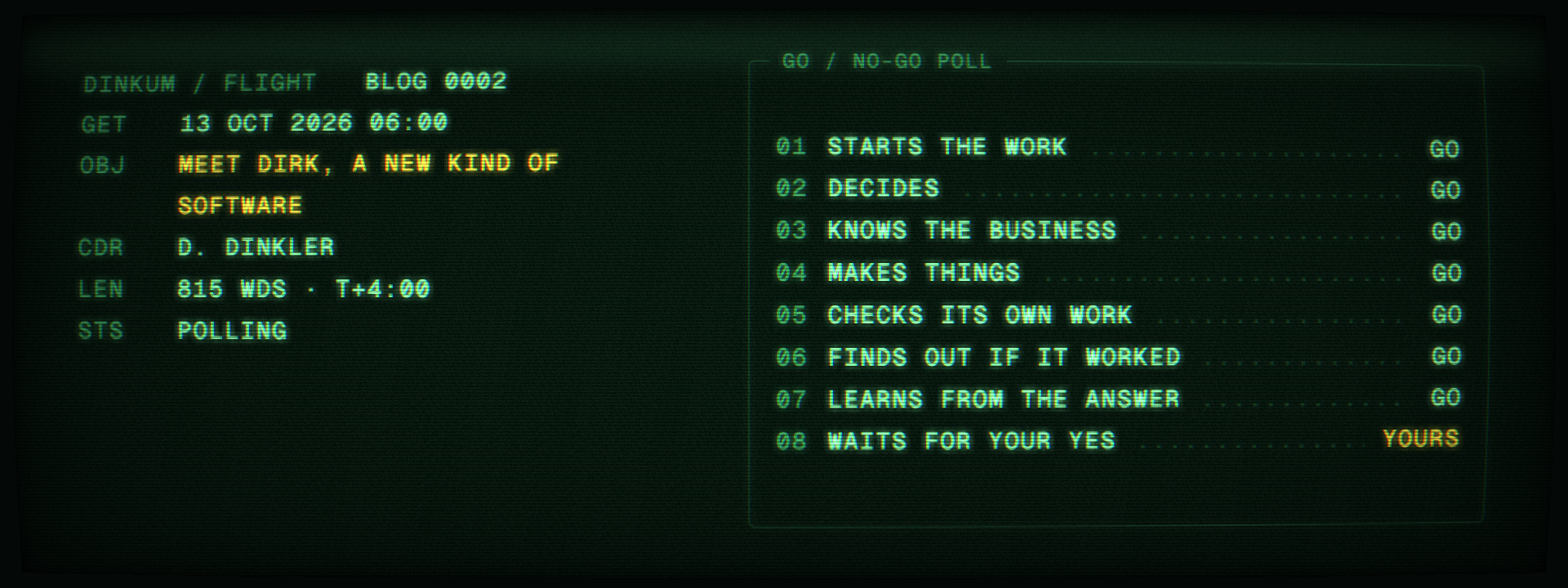
Dirk is the snake in our logo, and he's the one doing the work. Most software is forms and tables, and most AI looks things up. Dirk decides what to do, does it, checks it, and learns from what happened.
Who Dirk is

Dirk Dinkler is the pixel snake from the game on the old Nokia phones, the one that goes round eating dots and getting longer. He's our logo, chasing his own tail. He's also the name for the part of Dinkum that does the work.
The dots he eats are opportunities: a search people have started making that nobody answers well, a page that's losing clicks, a broken link, a question ChatGPT answers with someone else's site. Every weekday morning he goes after one. On the weekend he sleeps.
Forms, tables and lookups
For as long as I've built software, it's mostly been forms and tables: a screen to put information in, and a screen to see it again. Even the clever stuff waits for a person to come along and drive it.
A lot of AI hasn't changed that as much as it looks. It finds things faster, writes a first draft, or passes a job between a few tools. That's useful, but someone still has to decide what's worth doing, do it, and check that it worked. Dirk does all three, on his own. Here's what that looks like.
What Dirk does
1. Dirk starts the work
Nobody opens Dinkum and presses a button. Every weekday morning Dirk wakes up by himself, looks at the site, and works out what to do. Normal software waits for you. Dirk turns up.
2. Dirk decides
On any morning there are dozens of things he could do. He weighs them against each other, picks one, and writes down why, including what he turned down and the reason. You can read his thinking for every change he's ever made.
3. Dirk knows the business
He keeps a notebook for every site: what's true about the product and the prices, how the brand talks, the searches he's going after, and everything he's tried. He reads it before he writes a word. If a page says something the notebook contradicts, fixing that comes first.
4. Dirk makes things
What he hands over isn't a recommendation. It's the change itself: a page written for a real search, a comparison, a free tool, even pictures drawn in the site's own style. No two mornings look the same, because the site, the searches and the competition keep moving, and he works from what's in front of him, not from a template.
5. Dirk checks his own work
Before anything reaches you, a second AI reviews the change, the pages are built and looked at on a desktop and a phone, and a check confirms he only touched what he's allowed to. Most mistakes are caught there, before they get to you.
6. Dirk finds out whether it worked
Two and four weeks after a change goes live, he measures those pages against the rest of the site, so a busy month can't make a weak change look good. Every change gets a verdict: it worked, there was no clear change, or it made things worse.
7. Dirk learns from the answer
The verdicts go back in. Each kind of change keeps a hit rate, and the hit rate weighs on what he picks next, so the work that moves a site gets chosen more often and the work that doesn't, less. Every Dink that works, he grows a little. That's the Snake part.
8. Dirk waits for your yes
Everything up to the last step is Dirk's, and the last step is yours. Each change arrives as a pull request you can read, question or close, and nothing goes live until you approve it. He's a very polite snake. Autonomous doesn't mean unsupervised.
Why it feels different
Put together, it's less like using software and more like working with someone. You tell Dirk what you care about, say a page for every platform you support or every city you serve, and he works through it a step at a time alongside everything he notices by himself. Some mornings he does something I wouldn't have thought of. That's the part normal software can't do.
I don't think he's finished, and I don't think it's only an SEO idea. It's what software looks like when it can do the job, not just hold the information about the job. You can see what his mornings look like in my first post, and how Dinkum works goes through the machinery.