
SERP monitoring that updates your pages when the results move
Short version: most SERP monitoring tells you where you rank. Dinkum's watches what the pages above you say. Once a week, for every page it has written, it reads Google's top five results again and compares them with the brief the page was written from. When three or more of them start covering a section, a name or a phrase your page doesn't, it puts a refresh on your calendar with the new items named, and you approve it like any other Dink.
Rankings move for a reason. Usually it's that the pages Google prefers have changed: new ones have climbed in, and between them they now answer something yours doesn't. A rank tracker shows you the drop after it happens. Reading the pages that rank shows you the cause, often before the drop.
What changed on one search in a week
Stickybeak is our own analytics product, and Dinkum writes its guides. On 8 October, the top five Google results for "how to check website traffic" were a mix of guides and checker pages. By 15 October, all five had been replaced.
8 October
- 1
websiteseochecker.comWebsite Traffic Checker | Organic Search Traffic & Keywords - 2
thehoth.comThe Best Website Traffic Checker Tool - 3
elementor.comHow to Check Website Traffic for Any Site [7 Best Tools] - 4
rankifyer.comFree Website Traffic Checker - 5
leadfeeder.comWebsite Traffic Analytics: 8 Key Metrics
15 October
- 1
ahrefs.comWebsite Traffic Checker: Estimate Any Site's TrafficNew - 2
seranking.comFree Website Traffic Checker: Estimate Organic & PPCNew - 3
reddit.comIf anyone needs a free tool to find out a website's trafficNew - 4
semrush.comWebsite Traffic Checker: Check Any Site's Traffic for FreeNew - 5
spyfu.comCheck Any Website's TrafficNew
Now shared by 3 or more of them, and not on our guide
- SectionBulk-check traffic for multiple websites4/4
- SectionWhat is Website Traffic Checker?3/4
- paid traffic 4/4
- site traffic 4/4
- PPC 3/4
- AI Overviews 3/4
- traffic estimates 3/4
- competitor traffic 3/4
- keyword rankings 3/4
- 4 more
Dropped out
- traffic sources
- bounce rate
- organic search
- traffic analysis
- SimilarWeb
- 8 more
The new five are tools that estimate any website's traffic, written for people sizing up a competitor. The old five were mostly about reading your own analytics. Google changed its mind about what this search is for, and the guide hadn't caught up. Reddit's page can't be read without signing in, so the counts are out of the four pages that could be.
Not every row deserves a paragraph. "Competitor traffic" and the bulk-check section are real gaps for a guide on this search. Bounce rate dropping out says the search has moved away from on-site analytics. The refresh covers what's true and useful to the reader, and says what it skipped.
What a check looks like in your dashboard
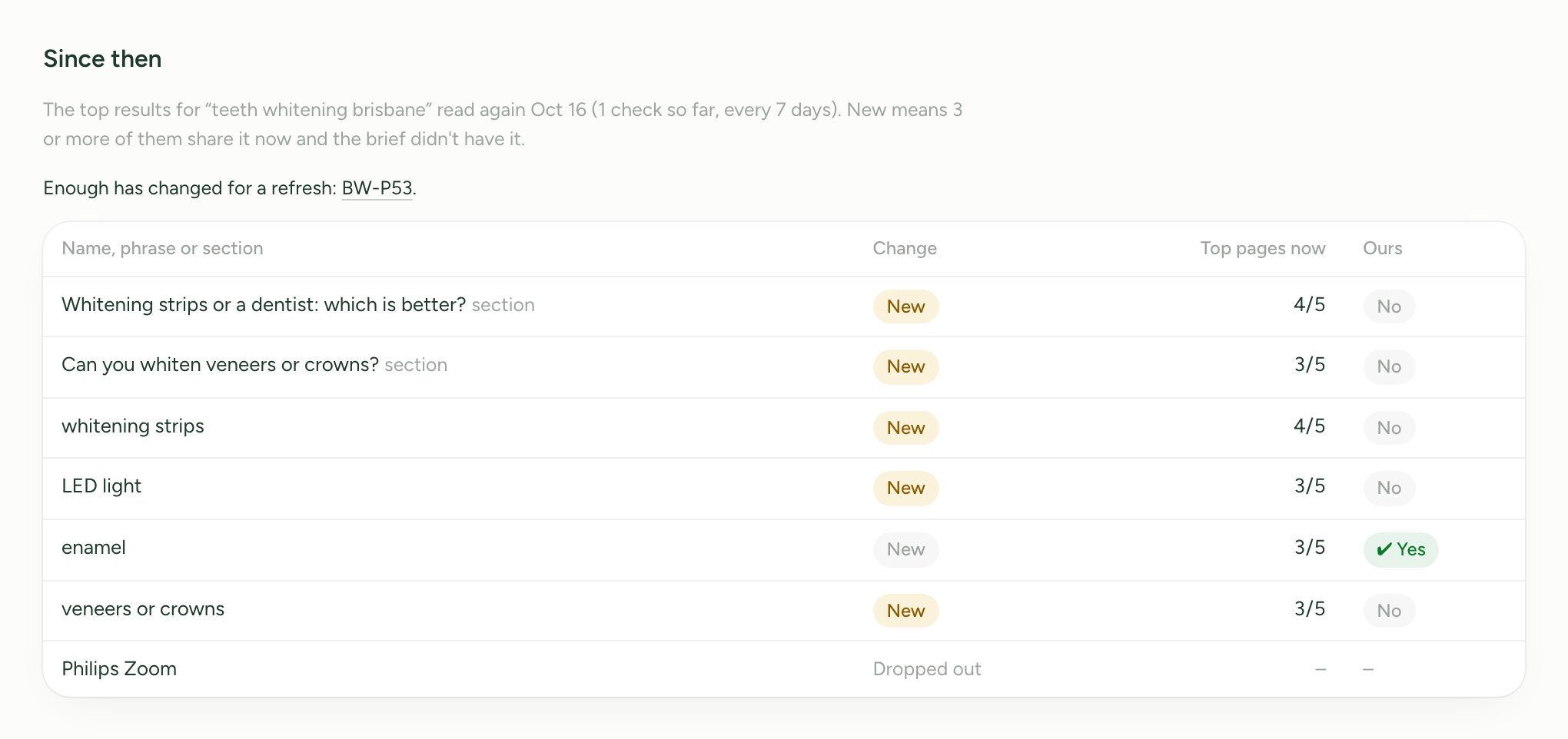
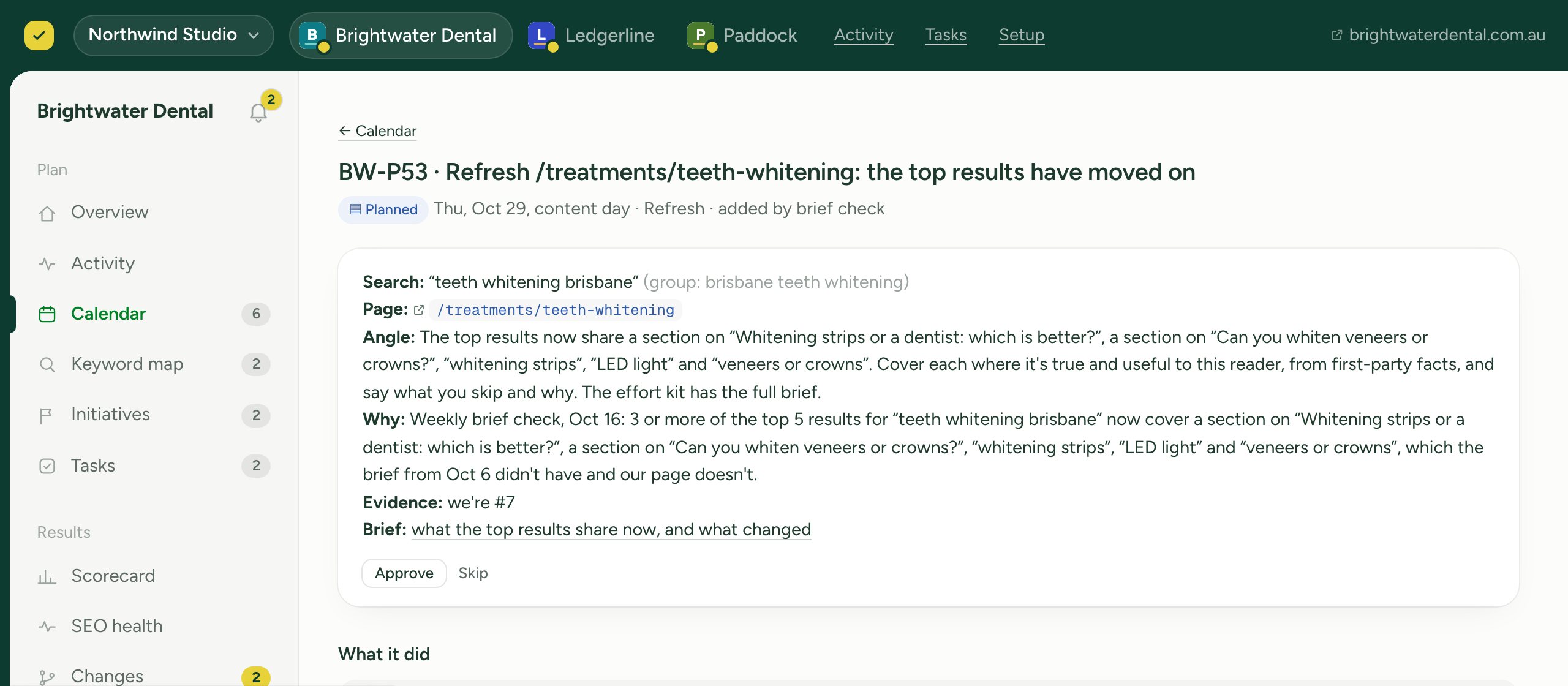
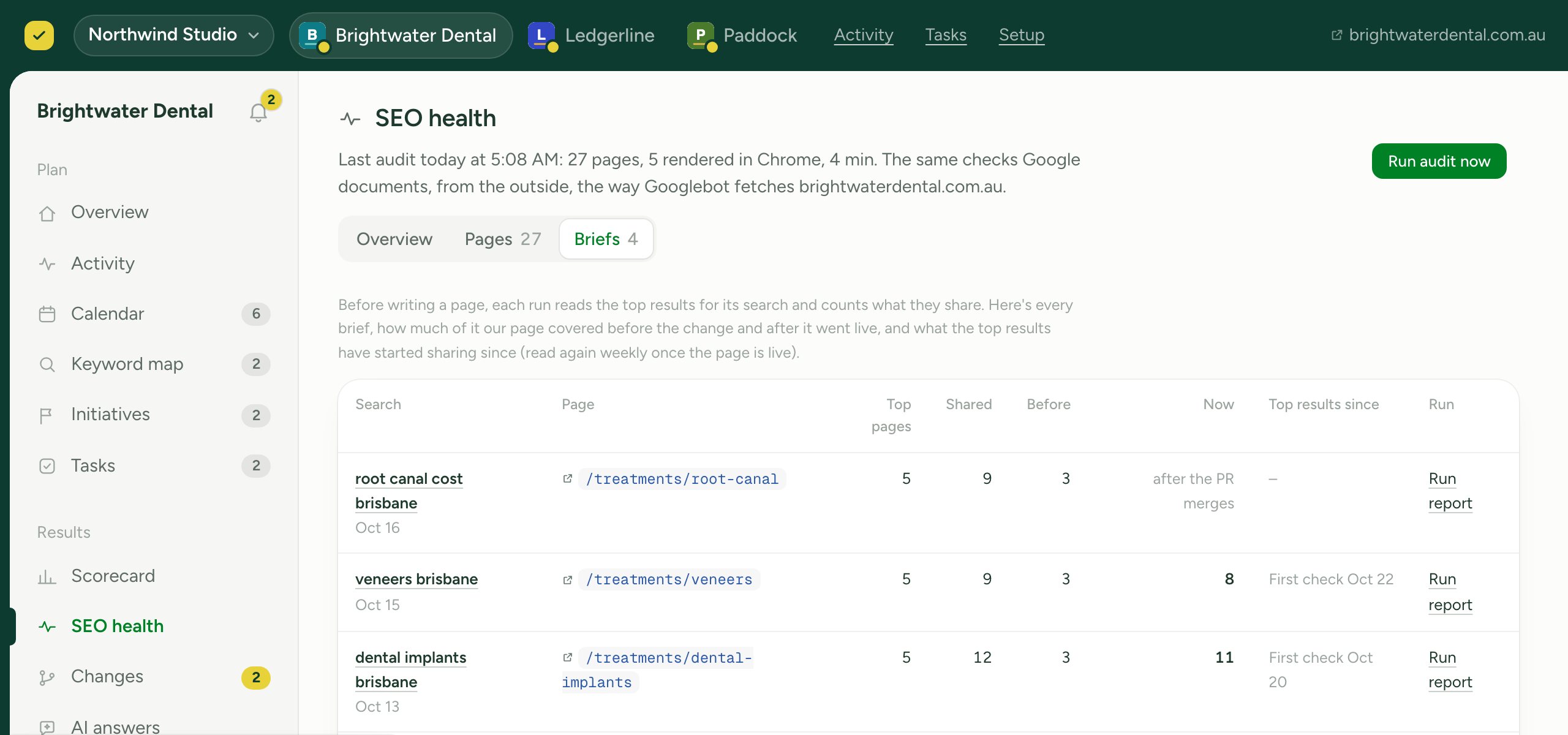
Every check is kept under SEO health, then Briefs, on the brief it was compared with. This one is on our made-up demo dental practice, so the numbers are examples, but the screen is the real one. The top results for "teeth whitening brisbane" started comparing whitening strips with a dentist and answering whether veneers and crowns can be whitened. The page had neither, so a refresh went on the calendar.
How it works
- Pick the pages to watch. Every live page Dinkum wrote or rewrote from a content brief, a week after the brief and then weekly. A page waiting for a refresh already isn't checked until it's done.
- Read the top five again. One look at Google's results for the page's search, in your market, and a fresh read of the five pages at the top: headings, text and length. A page behind a login or a bot check is left out rather than guessed at.
- Compare with the brief. New means three or more of the top pages share it now and the brief didn't have it. Dropped means the brief had it and they no longer share it. A read with too few pages counts for nothing, so a site that's down for a day never looks like a change.
- Check your page. Dinkum reads your live page and marks each new item yes or no, and notes where your page ranks in the top ten.
- Decide whether it matters. A new shared section your page lacks, or two or more new names and phrases, is enough for a refresh. Less than that is kept on the brief and counted again next week.
- Put a refresh on your calendar. It goes on the next free refresh day, with a why that names the new items. Skip it and Dinkum won't ask again unless something else changes.
- Make the refresh. On the day, Dinkum builds a fresh brief, rewrites the page to cover what's true and useful, and sends it as a pull request. Nothing goes live until you merge it, and the change gets its verdict at 14 and 28 days like every Dink.
Rank tracking, or this?
A rank tracker tells you
Where your page sits for each search, every day, and which pages moved above it. That's useful, and it's in your Dinkum dashboard too, straight from Search Console. It just can't tell you what to change.
This tells you, and does it
What the pages Google now prefers have in common that yours doesn't, read from the pages themselves. Then it plans the refresh, writes it in your site's code and sends it for your approval.
It runs on its own for every page with a brief. There's nothing to switch on, and each check is one lookup, so it stays cheap enough to run every week. The brief it compares against is explained on the content briefs page.
Questions
How is this different from rank tracking?
Rank tracking records your position. This reads the pages that rank and compares what they cover with your page. Rankings tell you something changed; this tells you what changed and fixes it.
How often does it check?
Once a week per page, starting a week after the page's brief, and only once the page is live.
Will it rewrite my pages every week?
No. Most weeks nothing material changes and nothing happens. A refresh is planned only for a new shared section, or two or more new names and phrases your page lacks, and you can skip any refresh.
What if a new item is filler?
It's a plain count, so some rows are filler: "URL" or "Google search" can be shared by three pages without meaning much. The refresh covers what's true and useful to your reader and says what it left out and why.
Which pages are watched?
Pages Dinkum wrote or rewrote from a content brief, once they're live. Every brief and its checks are under SEO health, then Briefs.