
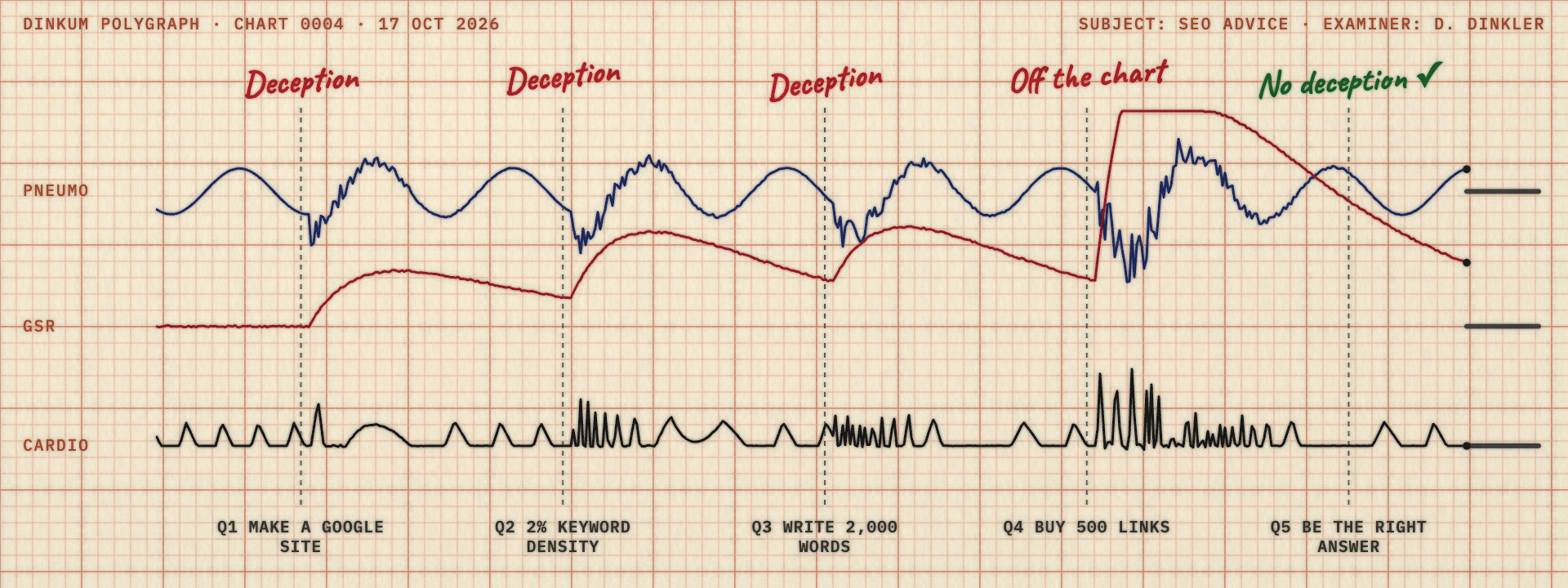
Most SEO advice is rubbish. Here's how Google actually decides.
A post doing the rounds on LinkedIn this month tells business owners to build a page on Google Sites and link it to their website. It won't help. Why it won't help is the most useful thing you can learn about SEO: Google is trying to show people the result they were looking for, and it has spent more than 25 years getting very good at not being tricked.

The advice doing the rounds
The idea goes like this. Make a free page on Google Sites named after the search you want to win. Put your business on it and link to your website. Some people go further and call it "Google stacking": Google Docs and Sheets full of links, all linked from a Google Site, on the theory that anything on Google's own domains carries extra trust. Gig sites sell it as a package for a few dollars.
It sounds clever because it uses Google's name. Here's what Google has actually said:
- On Google Sites, John Mueller of Google said in 2023 that the pages can be indexed but the platform isn't ideal for SEO, and suggested using your own domain instead.
- On building links from Google Sheets, back in 2017, his whole answer was: "Don't do that, do something useful instead."
- On "trust" from Google's own domains, he said in 2021 that Google has no metric specifically for trust. There's no special pass for being on sites.google.com.
- On links you create yourself on free platforms, he said in 2020 that this kind of activity has zero value for SEO.
We looked at a public Google Sites page. Its outbound links go through a google.com redirect. How Google treats those for ranking isn't public, and I won't pretend to know. It doesn't matter much anyway. A page nobody visits, linking to your site, is not a reason for anyone searching to want your page.
What Google is actually trying to do
Google has one job when you search. Put the result you were looking for at the top, so you're happy with Google and come back. Everything else is machinery for that. Here's what's public about the machinery.
It reads the web, then picks
Google's own explainer splits Search into three stages. Crawling: Googlebot finds pages through links and sitemaps. Indexing: it works out what each page is about, groups duplicates and picks one version to keep. Serving: when someone searches, it ranks what it has by relevance and quality, adjusted for their location, language and device. Not every page makes it through. Google also says it doesn't take payment to crawl a site more often or rank it higher.
Lots of systems, not one score
Google publishes a list of its ranking systems. It names more than a dozen: BERT, MUM, RankBrain and neural matching for understanding language; passage ranking for finding the right part of a long page; freshness, reviews, original content, reliable information and site diversity; deduplication; and SpamBrain for spam. Links are on the list too: link analysis and PageRank, which Google calls one of its core systems from launch. One system among many, not the whole game. A Google engineer, Gary Illyes, told a conference in 2023 that links aren't in the top three things that matter, and in 2024 that Google needs very few links to rank a page.
It learns from what people pick
This is the part the tricks ignore. In the US government's antitrust case against Google, the judge's 2024 ruling describes a system called Navboost. It pairs searches with pages by remembering what people clicked, using about 13 months of search data. A Google document quoted in the ruling calls Navboost one of the most powerful ranking components it has had. A related system, Glue, does the same for everything else on the results page. In 2024 a set of Google's internal API documents leaked too, with attributes named goodClicks and badClicks. Google warned against reading too much into them, and nobody outside Google knows how much each one counts.
You don't need the weights to see the shape. Google watches which result people choose for a search, and whether that choice seemed to do the job.
And people check the results
Google also has people outside the company, its search quality raters, rate results against a 182-page set of guidelines. The main question they answer is whether a result fully meets what the searcher needed, or fails to. Google says no single rating changes any page's ranking. The ratings tell Google whether its changes are making results better, so the whole system gets tuned towards the answer a real person would call right.
Why every trick has the same flaw
Every SEO trick fakes a sign that a page is the right answer, instead of making it the right answer.
- Links used to mean somebody vouched for you. So people bought them, swapped them and built networks of sites to make them. Google built SpamBrain to spot both the sites buying links and the sites selling them, and says it neutralises those links.
- Keywords used to mean a page was about something. So people stuffed them in. Keyword stuffing is now a named spam policy.
- Dates used to mean a page was fresh. So people changed the date without changing the page. Google's guidance on helpful content lists exactly that as a warning sign.
- Big websites rank well, so people rented pages on them. In 2024 Google made that its own spam policy, and later said it applies whether or not the big site is in on it.
Google earns its money because people trust its results. A trick that works is a bug in Google's product, and Google has every reason to fix it. Even when one works for a while, you're building on something you'll lose, and the page you made in the meantime did nothing for the customer who landed on it.
The rubbish, one by one
| The advice | What Google has said | Do this instead |
|---|---|---|
| Make a Google Site, or "stack" Google Docs and Sheets | Google Sites isn't ideal for SEO; use your own domain. Links you drop on free platforms have zero value. | Put the page on your own site, where it builds something you keep. |
| Buy a link package, list in 500 directories, build a network of sites | Buying links, low-quality directories and keyword-rich guest posts are all named as link spam. | Get mentioned by places your customers already read. |
| Hit 2% keyword density | Keyword stuffing is a spam policy. | Use the searcher's words where they'd look: the title, the main heading, the first sentence. |
| Add "LSI keywords" | Mueller, 2019: there's no such thing. | Cover what a reader expects, where it's true. Read what the top pages share first. |
| Write 2,000 words | Google's own guidance: it has no preferred word count. | Make it as long as the answer needs. |
| Raise your Domain Authority | Domain Authority is a score from an SEO tool company. Google doesn't use it. | Watch your clicks in Search Console. |
| Pay an indexing service, or ping Google | Google switched off its sitemap ping in 2023 because most of what came in was spam. Its Indexing API is only for job posts and livestreams. | A sitemap, Search Console and links from your own pages. |
| Change the date so it looks fresh | Listed as a warning sign when the page hasn't really changed. | Update the page, then the date. |
| Publish 500 AI pages | Many pages made to rank without adding value is scaled content abuse. | Fewer pages, each with something only you can say. |
| Optimise for E-E-A-T | Google says E-E-A-T isn't a specific ranking factor, and of its parts, trust matters most. | A real author, facts you can back up, and a way to reach you. |
| Rent a page on a big website | Site reputation abuse, a spam policy since 2024. | Build on your own domain. |
What actually works
Be the result the person was looking for. That sounds like a slogan, so here's what it means on a Tuesday morning:
- Find the searches you deserve to win. In Search Console, look for searches where you already show up but people don't click, or where you sit just off page one.
- Answer the search in the first lines. Someone typed a question. The first sentence of your page should answer it, with a number if there is one.
- Cover what a reader expects. Read the pages that already rank and note what most of them explain. A reader will expect yours to explain it too, where it's true for you.
- Add what nobody else has. Your real prices, your photos, your numbers, your answer to the question customers ask you on the phone. This is what makes Google's systems, and the person searching, pick you over the five pages that say the same thing.
- Make sure Google can read it. No accidental noindex, no answer hidden in an image, a page that loads fast on a phone, links to it from your other pages.
- Get talked about by real places. A local paper, a supplier's page, an industry list. One mention from somewhere people read beats a hundred from places nobody does.
- Judge it properly. Wait four weeks, then compare the page's clicks with the four weeks before, against how the rest of your site moved. If everything rose 20%, your change didn't do anything you can see.
None of it is a hack. It's slower to explain and faster to work, and nothing Google ships next year can take it away from you.
Why I built Dinkum this way
Dinkum does that list, one change at a time, five mornings a week. Each change is a Dink: a pull request on your own site that you approve or close. Then it judges every Dink at 14 and 28 days against the rest of your site and tells you plainly whether it worked.
Its rules also say what it won't do. It won't build pages on Google Sites, Medium or Google Docs to rank in your place. It won't build rings of sites linking to each other, and it won't use indexing services. That's not because we're saints. None of it lasts, and none of it helps the person who searched.
Everything above you can do yourself, and our guides give away every step. Start with how Dinkum works, or how to get named in ChatGPT, which runs on the same idea: be the right answer, then make it easy to find.